Projects
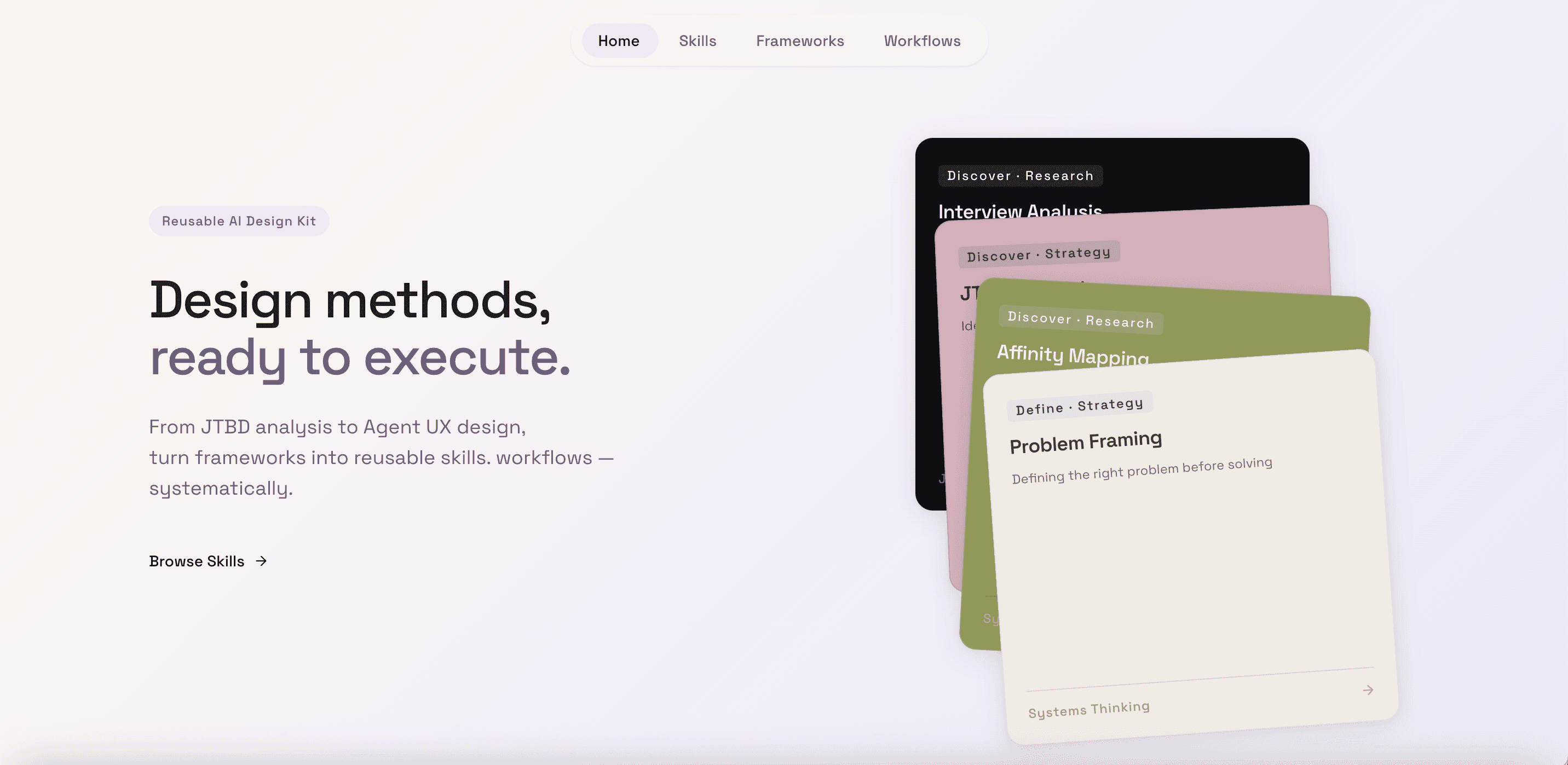
Turning Design Methods into Reusable Skills for the AI Era. Click to view the website.
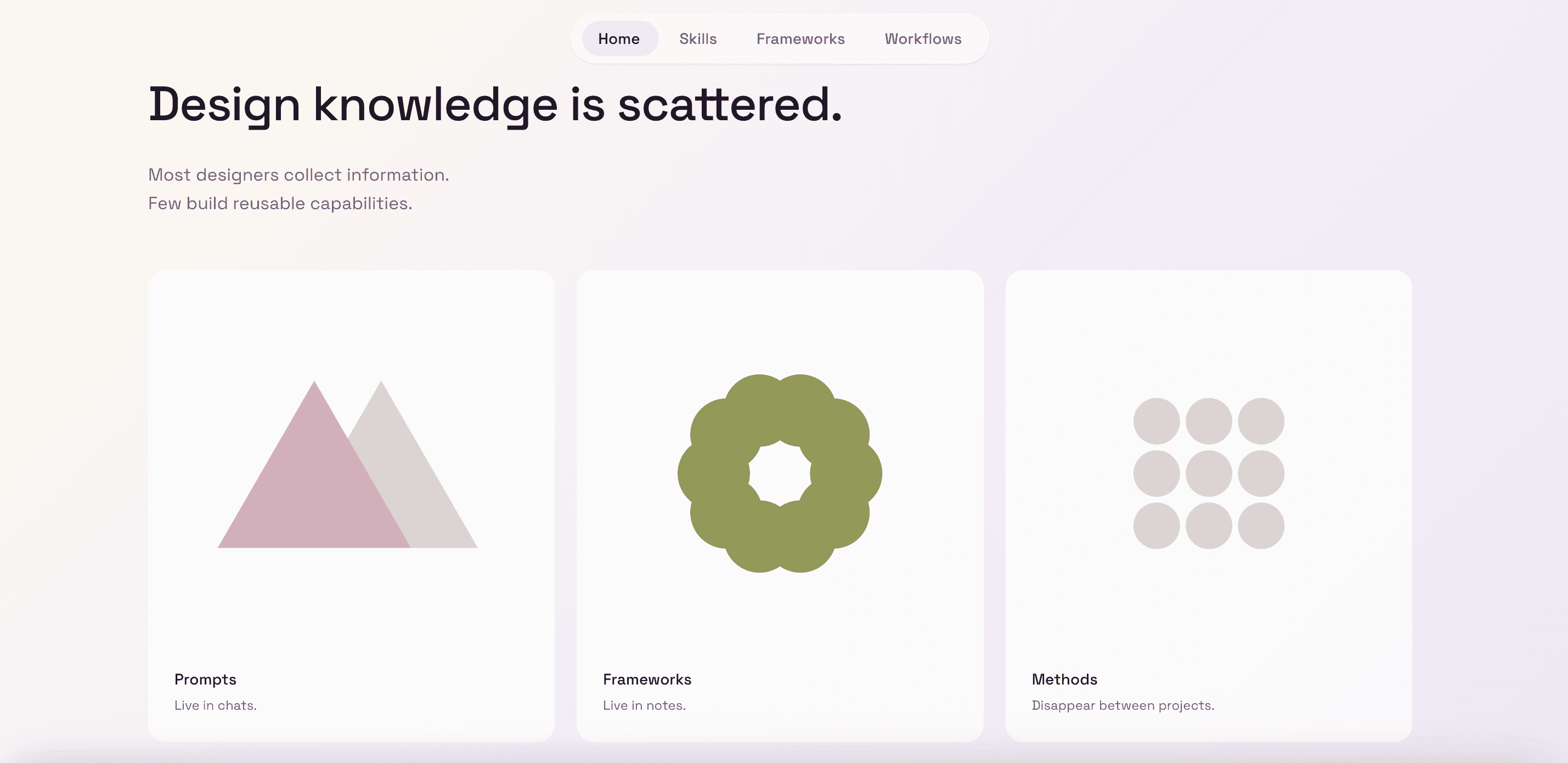
As AI tools became part of my daily workflow, I found myself collecting prompts, frameworks, and templates across multiple platforms. While the amount of knowledge grew, its usability declined. Prompts were buried inside chat histories. Frameworks lived in scattered documents. Valuable methods were repeatedly rediscovered rather than reused.
This project began as a personal question: How might I turn design knowledge into reusable capabilities instead of static documentation?
Type
Vibe Coding
Tools
ChatGPT, CodeBuddy, Github
Time
2026
Duration
2 Days
Research & Insights
I analyzed my own workflow across research, strategy, UX design, and AI product development. Three recurring patterns emerged:
1. Frameworks shape thinking
Frameworks such as JTBD, Systems Thinking, and Human-Centered AI helped define how problems were interpreted.
2. Skills produce outcomes
Most design work consists of repeatable activities:
Interview analysis
Opportunity mapping
Agent design
Problem framing
These activities could be modularized.
3. Workflows connect skills
Complex outcomes rarely come from a single method.
Instead, they emerge from a sequence of reusable capabilities. For example:
→ Research Analysis
→ JTBD Extraction
→ Opportunity Mapping
→ AI Feature Discovery
Solution
I designed a lightweight Design Toolkit organized around:
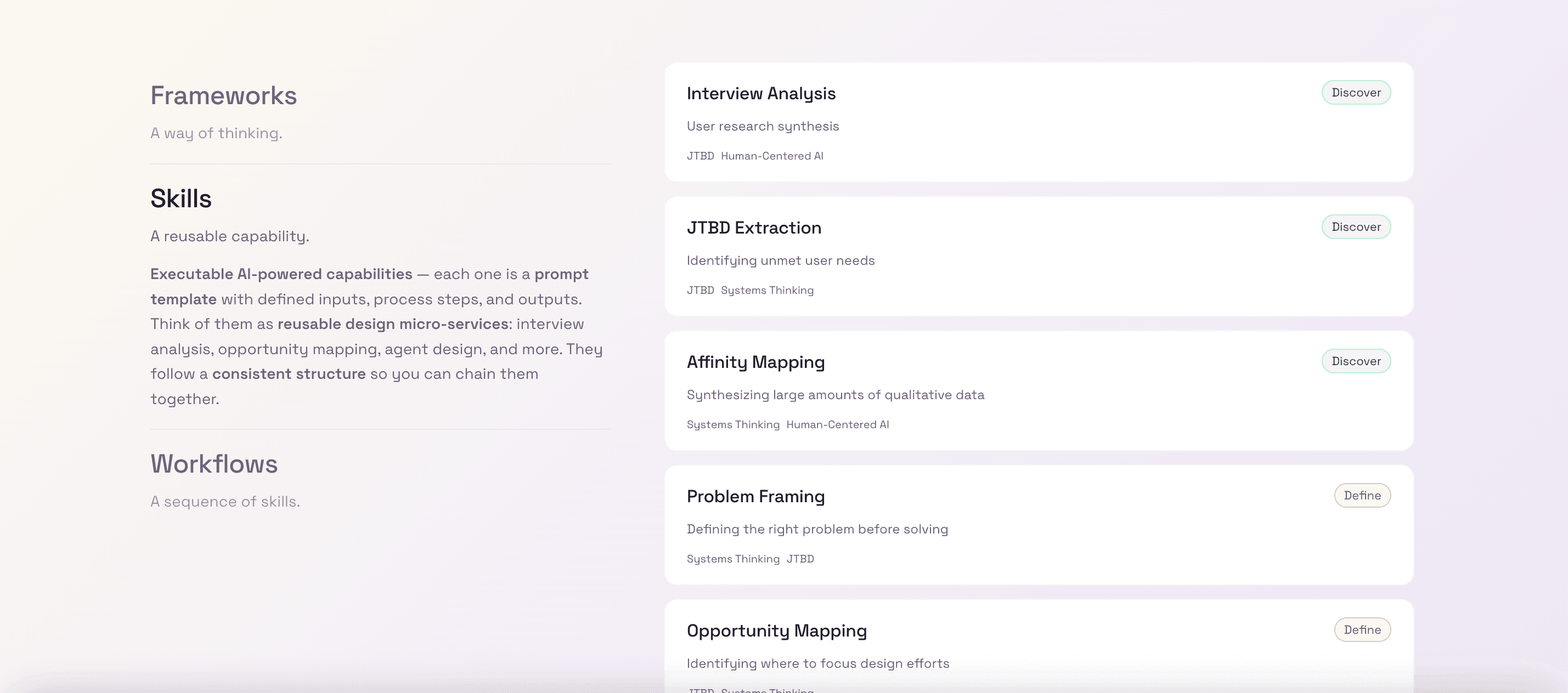
Framework → Skill → Workflow
Instead of storing information, the system helps retrieve actionable methods.
The interface prioritizes:
Fast discovery
Reusability
Search-first interaction
Copy-and-use execution
Rather than browsing documents, designers can locate a capability and immediately apply it to a task.
Skills as atomic units
Instead of organizing content by documents or prompts, the system organizes around reusable capabilities.
Each skill contains:
Context
Inputs
Process
Outputs
Prompt template
Workflows as orchestration
Workflows visualize how multiple skills combine into larger outcomes.
This allows designers to move from isolated techniques to repeatable systems.
Next project